
Course/English and Hindi
The Professional's Approach to Options Trading
Stop looking at options as price charts. Start understanding what you're actually trading.
Learn how option premiums behave, how to translate a market view into a suitable options structure, and how to understand the mathematics of risk.
₹999one-time payment · lifetime access
Enrolment for the full course is not open yet. Lesson 1 will be free on YouTube.
- 18
- lessons in 5 parts
- ≈4 h
- in chapters of a few minutes
- EN · HI
- English and Hindi
- 18
- workbook sheets, one per lesson
- ₹999
- once, lifetime access
Tradzo Research · SEBI Registered Research Analyst · INH000024675Registration relates to Tradzo's research service and is not an endorsement of this course.
From Lesson 1 · The Direction Trap
You bought a call. The index went up. Did you make money?
A hypothetical index at 20,000. Strike 20,000, 7 days to expiry. You paid ₹178.39. Move the index, let days pass, change implied volatility, and watch what the premium does.
40 of 100 model paths from here end above break-even (20,178) at expiry.
Each input changed one at a time from the entry, in this order: time, then the move, then volatility.
Right on direction. Still down.
- Break-even at expiry
- 20,178
- Delta
- 0.68
- Next day costs
- −₹14.42
- Days left
- 4
Hypothetical index. Premium by Black-Scholes at a 6.5% rate, before costs. The shaded range is a model of possible paths, not a forecast. Illustrative only, not a recommendation.
Six things you can work through on your own by the end.
- 01Explain why a premium moved, by separating direction, time and volatility.
- 02Form a view on the index, and use the premium chart only to read demand and supply.
- 03Read an option chain: open interest, change in open interest, and who is building or closing positions.
- 04Choose a strike, an expiry and a structure that fit the view.
- 05Work out expectancy, drawdown and position size before a trade is placed.
- 06Write your own pre-trade checklist, risk limits and trading journal.
It starts from what a premium is made of, not from what a chart looks like.
Priced, not pattern-read
Lessons start from how a premium is priced, and re-price one option one input at a time: direction, time, volatility.
The view comes from the index
The view is formed on the index and the option chain. The premium chart is read for demand and supply only.
Worked by hand
Every lesson ends with a recap and one exercise on its workbook sheet, done on your own past trades.
Risk before the trade
Expectancy, drawdown and position size are worked out before a trade is placed, not after it goes wrong.
It teaches a method. It does not tell you what to buy or sell, or when.
It is not investment advice, and it does not include Tradzo's research service.
Nothing in it promises or implies a return. Options trading carries substantial risk.
Five parts. Eighteen lessons.
Each part builds on the one before it. Open a lesson to see its chapters and workbook sheet. Planned chapters are marked ≈ until the lesson is released.
How an option is priced
Greeks, implied volatility, and both sides of a premium.
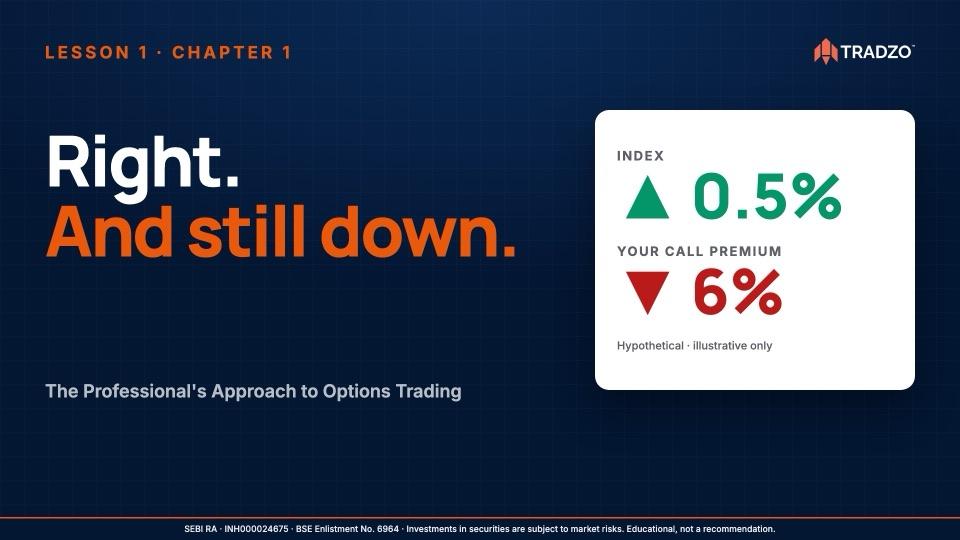
01The Direction TrapBeing right on direction is not enough. One option, re-priced one input at a time.Free13 min
- 1. The trade that was right3:44
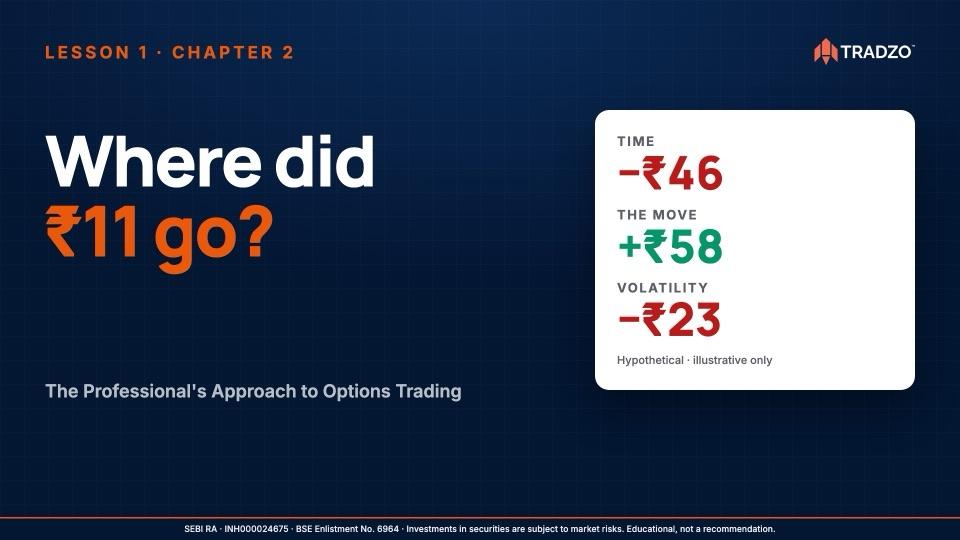 2. Where the money went3:07
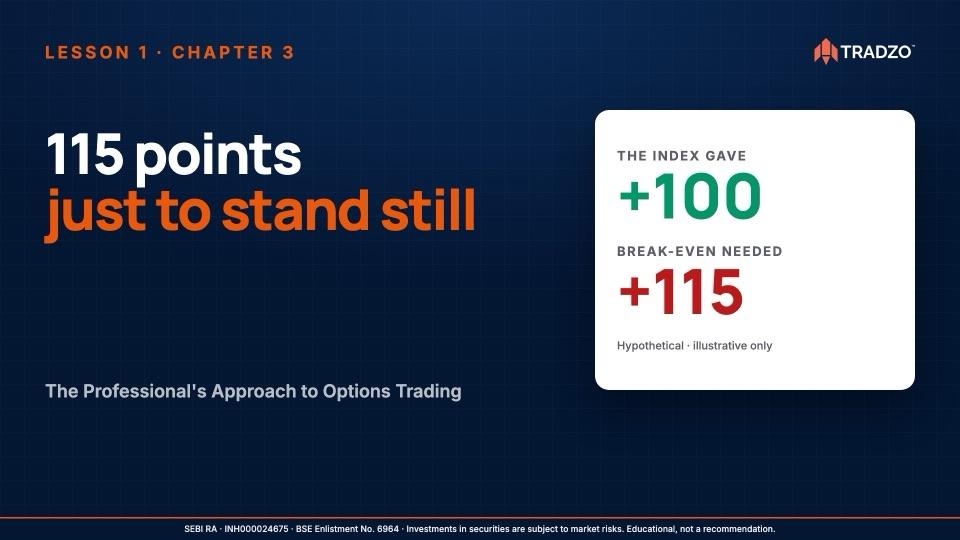 3. The break-even move1:37
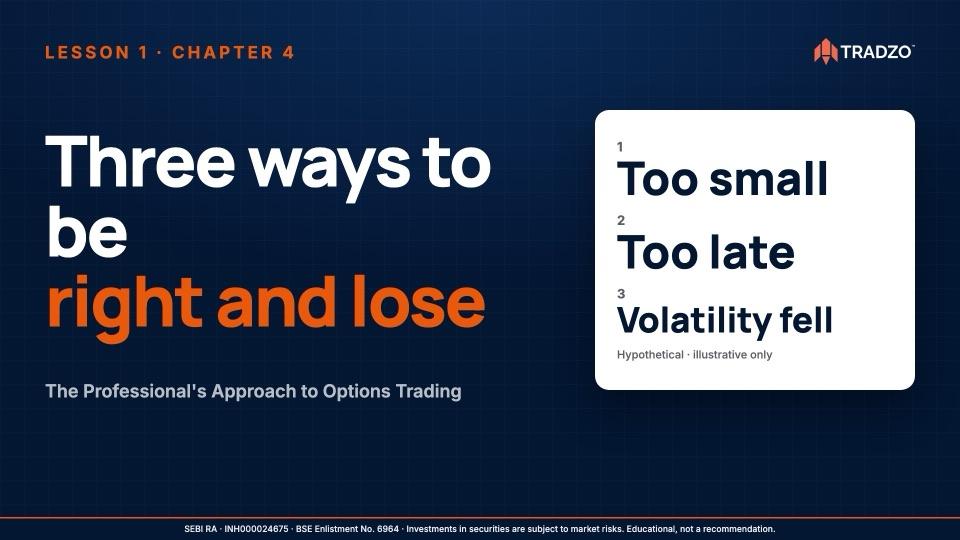 4. Too small, too late, volatility fell2:38
 5. Recap and exercise1:31
Workbook sheet 1: Right and still down
02What Premiums Really PriceThe Greeks, implied volatility, and how to tell when volatility is high or low.15 min
 1. Delta and gamma3:36
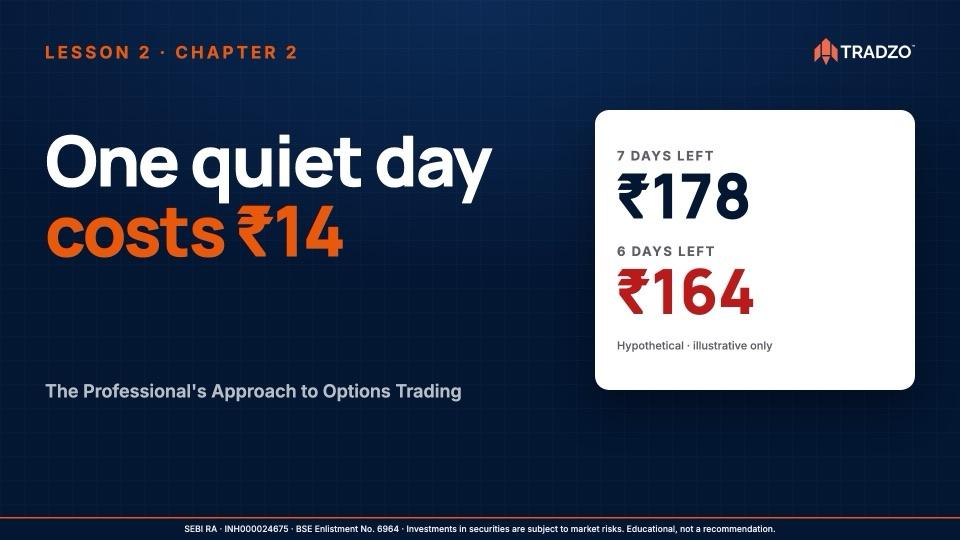 2. Theta and vega1:53
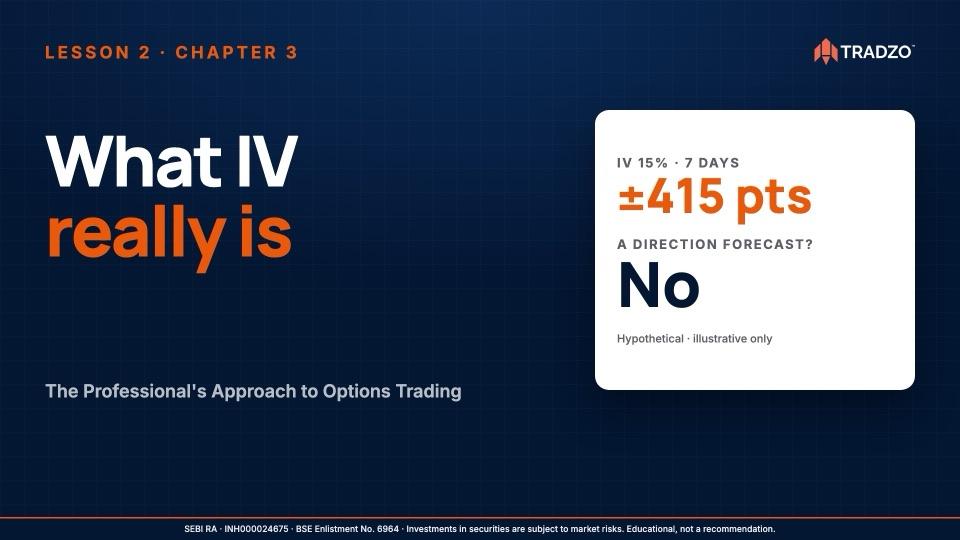 3. The price of uncertainty2:41
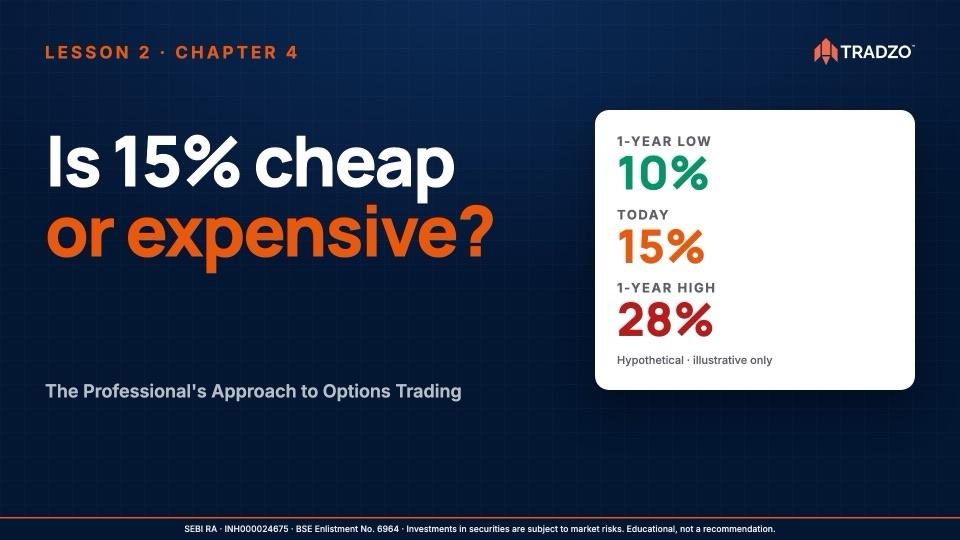 4. Is volatility high or low3:02
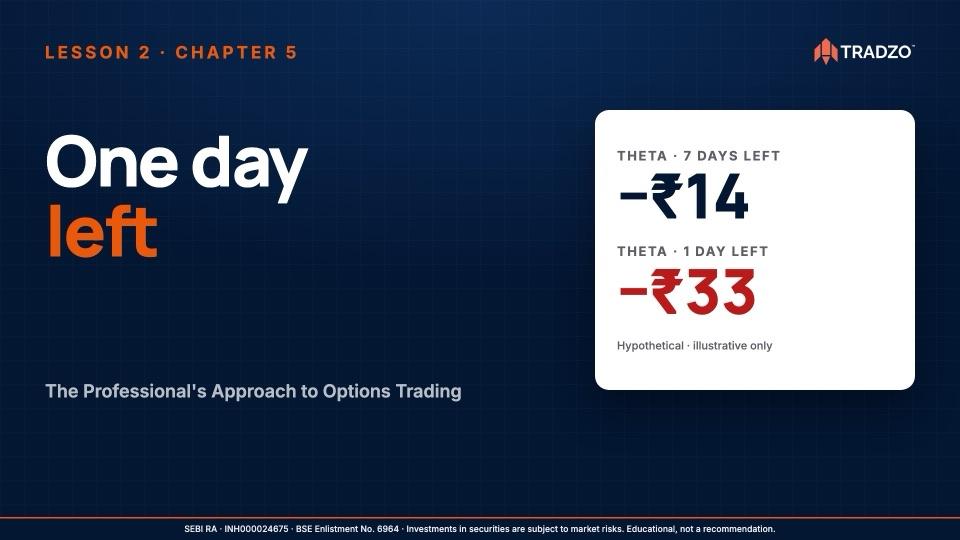 5. Closer to expiry2:17
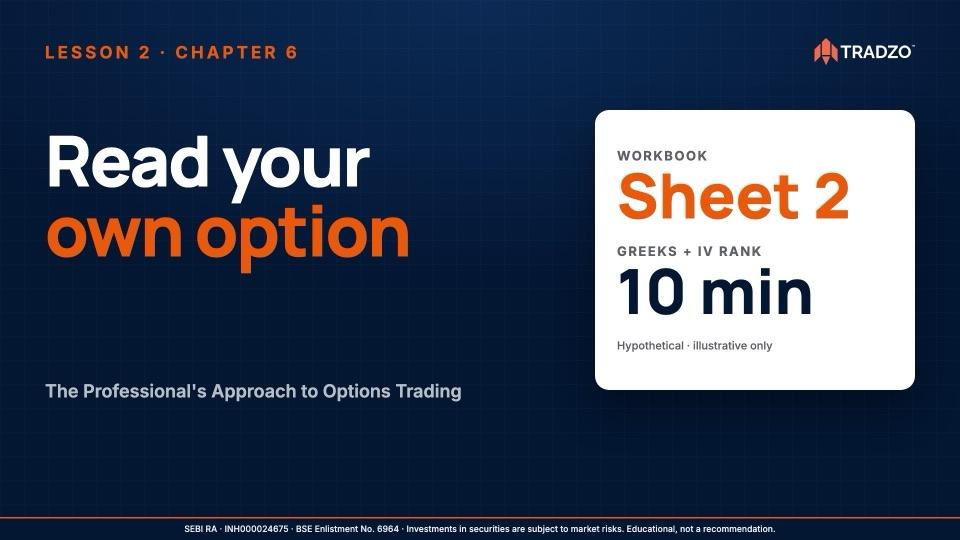 6. Recap and exercise1:47
Workbook sheet 2: Greeks card and IV sheet
03Buyer and SellerThe two sides of every premium: payoff, margin, who earns the decay, and puts as the mirror.≈ 14 min
- 1. The other chair≈ 2:25
- 2. What the seller is paid for≈ 2:20
- 3. Selling without a hedge≈ 4:05
- 4. Puts, the mirror≈ 2:10
- 5. Putting a ceiling on the loss≈ 1:50
- 6. Recap and exercise≈ 1:30
Workbook sheet 3: Two sides
Where the view comes from
Forming a view on the index, and reading the option chain for who is doing what.
04The View Is on the Index, Not the Premium ChartDirection, distance, time and volatility. The premium chart is for demand and supply only.≈ 13 min
- 1. The support that time broke≈ 2:25
- 2. One index level, many premiums≈ 2:10
- 3. The view card≈ 3:35
- 4. What the premium is good for≈ 2:45
- 5. Recap and exercise≈ 1:30
Workbook sheet 4: The view card
05Reading the Option Chain on the TerminalOpen interest, change in open interest, range and activity.≈ 14 min
- 1. What open interest is≈ 2:35
- 2. The layout, and the first look≈ 1:45
- 3. Where the open interest stands, and where it changed≈ 3:30
- 4. Two summary numbers, and the cost of trading≈ 2:35
- 5. The same four looks on the Tradzo Terminal≈ 2:00
- 6. Recap and exercise≈ 1:35
Workbook sheet 5: Four looks
06LB · SC · LU · SBLong build-up, short covering, long unwinding, short build-up: who is doing what, and how much it weighs.≈ 15 min
- 1. Two changes, four classes≈ 3:05
- 2. What each class says about the index≈ 2:20
- 3. How much each class weighs≈ 2:05
- 4. Reading the whole chain≈ 3:05
- 5. On the Terminal, and what this cannot tell you≈ 2:35
- 6. Recap and exercise≈ 1:30
Workbook sheet 6: Classify the chain
Choosing the trade
From a view to a strike, an expiry and a structure.
07Strike SelectionIn the money, at the money, one or two strikes out, deep out of the money, and when each fits.≈ 13 min
- 1. One view, five strikes≈ 2:10
- 2. Four outcomes for the same view≈ 2:50
- 3. One or two strikes out≈ 2:20
- 4. Deep out, and in the money≈ 2:30
- 5. The strike, from the view≈ 1:10
- 6. Recap and exercise≈ 1:25
Workbook sheet 7: Strike sheet
08Expiry SelectionHow the calendar changes the same view.≈ 12 min
- 1. Three expiries, one strike≈ 2:20
- 2. When the view is late≈ 2:45
- 3. Volatility, and what sits inside the expiry≈ 2:20
- 4. The last days≈ 2:15
- 5. Recap and exercise≈ 1:45
Workbook sheet 8: Expiry sheet
09Spreads for a Directional ViewDebit and credit spreads, and the in-the-money spread on expiry day.≈ 14 min
- 1. The same view, with a known loss≈ 2:30
- 2. What the second leg does to time and volatility≈ 2:50
- 3. Width, and the exit≈ 1:55
- 4. The same direction, paid by time≈ 2:35
- 5. The in-the-money spread on expiry day≈ 2:45
- 6. Recap and exercise≈ 1:25
Workbook sheet 9: Spread sheet
10Trading Volatility and TimeStraddles, strangles, condors and calendars, long and short.≈ 13 min
- 1. A view with no direction≈ 1:40
- 2. Buying movement≈ 3:00
- 3. Selling movement, with a ceiling≈ 3:00
- 4. Trading time itself≈ 2:20
- 5. Which structure, for which view≈ 1:25
- 6. Recap and exercise≈ 1:25
Workbook sheet 10: Movement sheet
11Matching the Structure to the ViewFrom view to strategy to strike to expiry, in worked cases.≈ 13 min
- 1. The order of decisions≈ 2:05
- 2. From the chain to the structure≈ 1:55
- 3. Two directional cases≈ 3:10
- 4. Two cases without a direction≈ 2:35
- 5. The fifth case, and the plan on one page≈ 1:50
- 6. Recap and exercise≈ 1:20
Workbook sheet 11: The plan on one page
The mathematics of survival
Expectancy, drawdown and position size, before a trade is placed.
12The Success Rate IllusionWhy expectancy matters more than how often a trade works.≈ 14 min
- 1. How often is not how much≈ 2:35
- 2. Expectancy≈ 2:35
- 3. The win rate you need≈ 1:45
- 4. The structure sets the bar≈ 2:15
- 5. Your own journal≈ 3:05
- 6. Recap and exercise≈ 1:20
Workbook sheet 12: The journal
13The Mathematics of DrawdownLosing and recovering are not symmetric.≈ 10 min
- 1. Down twenty, up twenty≈ 2:55
- 2. The recovery formula≈ 1:50
- 3. How often do streaks show up?≈ 3:20
- 4. Recap and exercise≈ 1:25
Workbook sheet 13: Streak sheet
14Position SizingThe stop on the index level, the risk in the structure, and margin for sellers.≈ 14 min
- 1. The same lots, a different risk≈ 2:25
- 2. A percent of what's left≈ 2:10
- 3. Sizing an option position from the index≈ 3:20
- 4. What you sold, and what you paid≈ 2:20
- 5. Two numbers, and four lines≈ 2:05
- 6. Recap and exercise≈ 1:25
Workbook sheet 14: Sizing sheet
15The Sizing ExperimentThe same hypothetical trades under five sizing rules.≈ 13 min
- 1. Fifty trades, ten thousand orders≈ 2:35
- 2. What we measure, and the setup≈ 2:10
- 3. Ten thousand orders≈ 2:35
- 4. The luck of the order≈ 2:35
- 5. How to read any backtest or study≈ 1:20
- 6. Recap and exercise≈ 1:20
Workbook sheet 15: The experiment
Behaviour and system
A written process that holds up after a loss.
16The Psychology of RecoveryHow loss aversion changes a plan after a drawdown.≈ 13 min
- 1. Relief has a price≈ 1:45
- 2. Losses weigh more≈ 2:35
- 3. What the habits cost, in R≈ 2:15
- 4. Getting it back≈ 2:35
- 5. Rules you make while calm≈ 2:00
- 6. Recap and exercise≈ 1:20
Workbook sheet 16: My rules
17Build a Trading Risk SystemA checklist, risk limits, a circuit breaker and a journal review.≈ 13 min
- 1. The page before the trade≈ 2:20
- 2. One trade through the page≈ 2:35
- 3. Limits≈ 1:25
- 4. The circuit breaker≈ 2:05
- 5. The journal, and judging a method≈ 2:35
- 6. The course on one card, and the close≈ 1:55
Workbook sheet 17: My risk system
18One Session, Start to FinishA past session worked through from the first read to the journal entry.≈ 13 min
- 1. Before the open≈ 1:50
- 2. The morning read≈ 2:35
- 3. The chain changes≈ 3:05
- 4. The next day, twice≈ 2:15
- 5. What the session was≈ 1:35
- 6. Your sessions, and the close≈ 1:25
Workbook sheet 18: Session log
A sheet for every lesson. Worked by hand, on your own trades.
Each lesson ends with a recap and one exercise, done on that lesson's sheet. This is Sheet 1, exactly as it ships with Lesson 1. The first row is the lesson's hypothetical example.
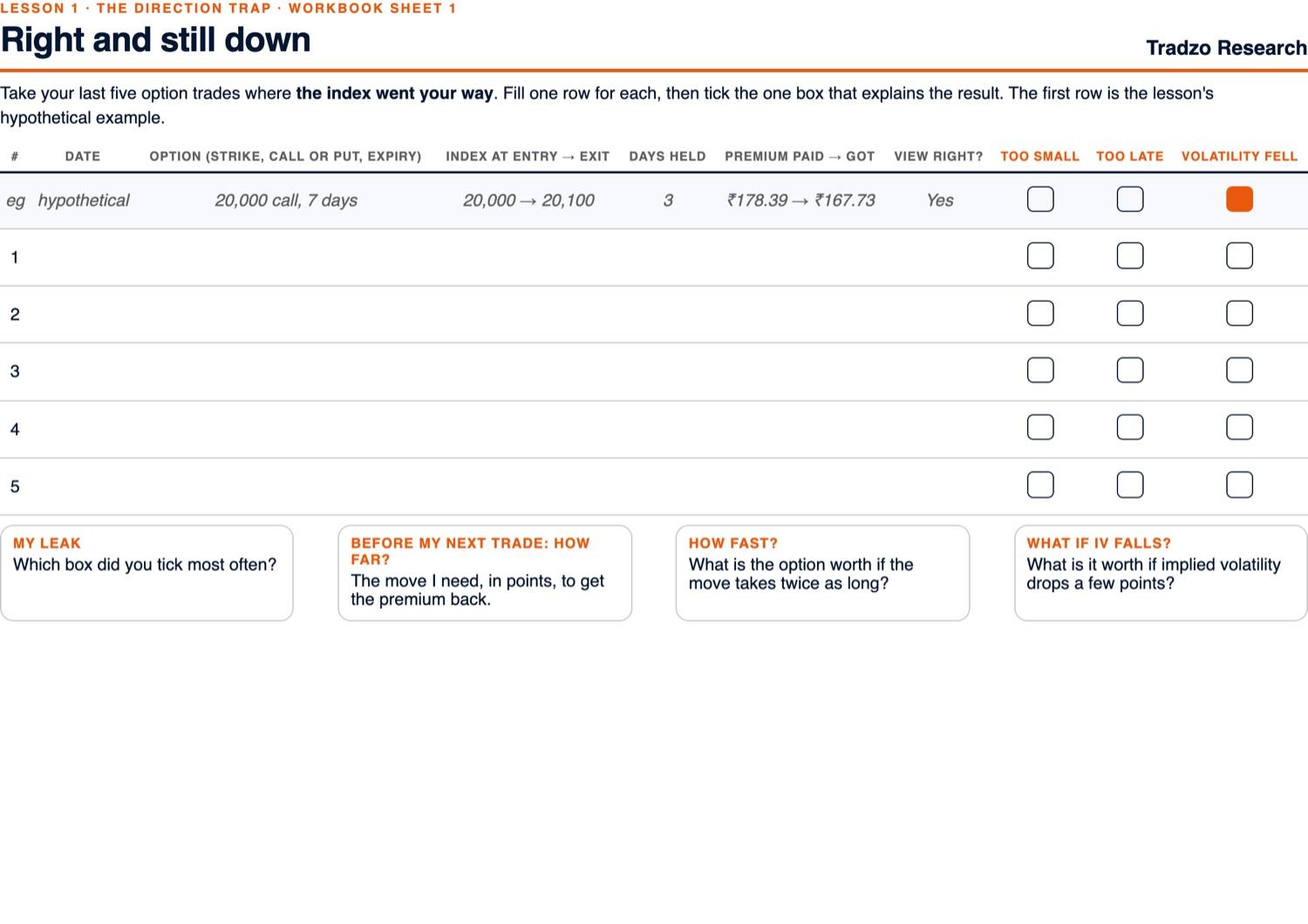
Enter one of your own call trades. The answers use the same pricing model as the lesson.
Break-even at expiry is 20,178.39, a move of 178 points from entry just to get the premium back.
A +100 point move in 3 days leaves the option at ₹190.86. The same move over 6 days: ₹127.70.
The same +100 in 3 days with IV at 12% instead of 15%: ₹167.73, against ₹178.39 paid.
From Part 4 · The mathematics of survival
The same trades. Five sizing rules. Very different accounts.
In Lesson 15, one fixed set of fifty hypothetical trades is run under five position-sizing rules. Only the size changes. Pick a rule, then shuffle the order of the trades.
Shuffle the same fifty trades. The four fixed rules always finish in the same place.
Hypothetical simulation from Lesson 15: fifty made-up trades, the same for every rule, costs left out. In the lesson's 10,000 random orders, the doubling rule finished below the start in 32.6% of them. Not a backtest, not a strategy, and not a recommendation of any sizing rule.
Lose 20%. You need +25% to get back.
A loss and the gain that undoes it are not the same size. Slide the loss.
From the Tradzo research desk.
The course is written and taught by the team behind Tradzo Research. It teaches the method. It does not include the research service, its calls, or any advice.
- Entity
- Tradzo Research
- Registration
- SEBI Research Analyst INH000024675
One price. The whole course.
18 lessons in 5 parts, about 4 hours in chapters of a few minutes.
Every chapter in English and Hindi. On-screen text is in English in both.
A workbook sheet for every lesson, with a recap and one exercise.
Lifetime access. One payment, no subscription.
Any device. Watch in a browser on a phone, tablet or computer.
Not included: Tradzo's research service, trade calls, tips or advice of any kind.
Before you start
Something else? Chat on WhatsApp, 9 am to 6 pm IST.
How long do I have access?
Lifetime. The course is a one-time purchase, not a subscription.
Which languages is it in?
Every chapter is in English and Hindi. On-screen text is in English in both.
Where can I watch it?
In a web browser, on a phone, a tablet or a computer.
Does it include research calls or advice?
No. The course is education only. Tradzo's research service is a separate product and is not part of the course.
Is the course endorsed by SEBI?
No. Tradzo Research is registered with SEBI as a Research Analyst (INH000024675). That registration covers the research service; it is not an approval or endorsement of this course.
When can I buy the full course?
Enrolment is not open yet. Join the notify list above. Lesson 1 will be free on YouTube.
Education only. Not investment advice. No returns are promised or implied. The course does not include research calls or any advisory service. Worked examples are for illustration and are not recommendations.
Derivatives risk: F&O trading carries substantial risk of loss and may not suit all investors; losses can exceed your investment. Read the disclaimer.